Simplified Stats Wizard
  • Home
  • Beginner
  • Low Intermediate
  • High Intermediate
  • Advanced
  • Stats Central
  • Home
  • Beginner
  • Low Intermediate
  • High Intermediate
  • Advanced
  • Stats Central
Search by typing & pressing enter

YOUR CART

​Beginner

(Serve-Receive Error Percentage is over 50%)

A Beginner team with many novice players who are still learning how to pass should focus on two stats: 
​
  1. Service Error %
  2. Serve-Receive Error %
Serve-receive strategy for Beginner teams

Because passing is difficult for beginners, it’s important to have many players on the court receiving.

​Number of receivers: 5 or 6

Offensive system for Beginner teams

Since the passing is poor, a Beginner offense must be very simple. Here are two good options:
​

6-6 System: Everybody is available to set the second ball
6-3 System: Three designated setters
 

Drills for Beginner teams

Serving Drills | Passing Drills | Setting Drills | Digging Drills | Hitting Drills | Team Drills
 

Focus on Serving First

If you serve well, you can put pressure on your own team to serve-receive better. When practicing, teach players to be mindful, not just serve ball after ball. They should take time to visualize serve and movements. 
 
Technique:
  • Low toss
  • High 5 motion - a compact, powerful swing
​

​Skill Drills - Serving


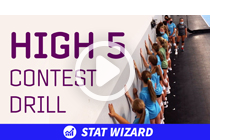
​High 5 Contest

 
Goal: Discover that you already know the proper arm swing for serving.
 
How to do it:
  • Split into 2 groups.
  • One group lines up on padded wall (usually near the basketball hoop).
  • On the count of 3, they all high 5 the wall in unison.
  • Try to be as loud as possible.
  • Group 2 goes to the wall and does the same thing and tries to be louder.
  • Contest goes on to find a winner - the loudest high 5 contact on the wall.​
Picture

​Net Serve Drill
 
Goal: Show players how high the ball should go and reinforce that it should be tossed vertically, not toward the server.
 
How to do it:
  • Stand at arm's length from net.
  • Toss the ball low, making sure it does not exceed the top of the net.​
  • The players don’t actually serve; they just toss, do their arm motion and let the ball bounce. 
Picture

​Wall Serve Drill
 
Goal: Gain consistency in toss, contact and power.
 
How to do it:
  • Start about 10 feet away from the wall.
  • Serve to a spot on the wall about 8-9 feet high.
  • Get 10 good serves to the spot.
  • Back up one long step and repeat.
  • If possible, continue until you are 30 feet from the wall.​
Picture

​Serving Over the Net Drill
 
Goal: Be able to serve over the net consistently.
 
How to do it:
  • This a one-way drill. Players serve then shag their ball, which gives them some conditioning too.
  • Start at mid-court, using the tossing and contact techniques practice in the Wall Serve Drill.
  • Take your time.
  • Load serving arm.
  • Low toss.
  • High 5, strong contact.
  • Not enough power? Use flat fist with thumb to the side of fingers.
  • 10 serves. Keep track of how many go over.
  • 8 out of 10, move back to 20 feet from the net.
  • Repeat and continue to move back until behind the end-line.​
Picture

Serving Competition
 
Goal: To serve consistently over the net under pressure.

How to do it:
  • Split team into two groups, try to distribute the serving skill evenly across both teams.
  • Two servers at a time, coach blows whistle.
  • If you make a good serve, you go to the other side.
  • If you miss, you go back to the end of your team’s line.
  • First team to get everyone to the other side wins.
Picture
Back to top
 

2nd Focus: Passing
 
Serve-receive passing is the most important skill in volleyball because it determines if you can control the opponent’s serve well enough to set yourself up for an attack. Once your team is able to serve tough, they can then practice how to pass tough serves. 
 
Technique:
  • Figure out where the ball is going early.
  • Move feet to the ball.
  • Set up platform.
  • Tilt to target.

Skill Drills - Passing


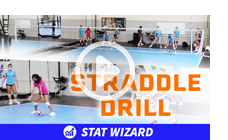
​Straddle Drill

 
Goal: Determine a player’s depth perception quality.
 
Notes:
  • Players who can’t do this drill naturally and easily will have a difficult time being a primary serve-receiver.
  • Even experienced players can fail this drill.
  • Young players who do best at this drill are generally those who have spent time throwing, catching and dodging things from a young age. It’s a Darwin test for them. 

How to do it:
  • Coach stands on the other side of net from players.
  • Players line up along sideline.
  • One player enters the court 10 feet in from the sideline, 15 feet off the net.
  • Coach tosses ball.
  • Player shuffles and stops where the ball will bounce between her legs.
  • Players should have both feet on the floor.
  • Short balls and deep balls are the most difficult, so when you find a player who reads the ball quickly, make it harder.
  • Each player gets one turn, then shags the ball and returns it to the coach. (The distances are far enough that the line thins out, and there’s very little waiting. It can be done double-sided if there’s a second coach.)
Picture

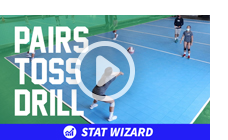
​Pairs Toss Drill - Passing
 
Goal: Learn basic platform passing technique.
 
Note: This is a “player-initiated drill” vs. a “coach-initiated drill.” This format allows all players to be active (no waiting in line), and the coach can walk around and provide feedback, particularly to those who need more help.
 
How to do it:
  • One player stands at the 10-foot line facing the end-line with a ball.
  • The other player stands about 10 feet away from this player and faces the net.
  • Player with the ball tosses medium high ball – at least as high as the top of antenna – to the passer.
  • Passer shuffles in athletic stance, joins hands and passes on forearms back to the tosser.
  • Do 10 passes with good form and switch places.
  • If players are more skilled, they can toss the ball deep and short to force the passer to move more.​​
Picture

​Triples Pass Drill
 
Goal: Learn to face ball, then tilt platform to target.
 
How to do it:
  • 3 players, 2 at the 10-foot line facing the end-line.
  • Player on right has the ball.
  • 3rd player is the passer at the 20-foot line facing the player with the ball and lined up with this player.
  • Player with the ball tosses to the passer.
  • Passer shuffles to the ball, tilts platform by dropping right shoulder and passes to target player.
  • Target gives ball to tosser.
  • Repeat 10 times and rotate positions.
  • If skill level is good, tosses can be more challenging to get to. ​
Picture
​
​Perfect Pass Competition
 
Goals: Learn to compete by making perfect passes. Learn teamwork and how to win.
 
Note: Gaming the game is OK. This is part of teamwork and figuring out how to win. For example, easy tosses make it easy to make perfect passes. If the coach wants it tougher, ask players to serve the ball beginning at the 10-foot line and then make it harder by moving back until they are behind the end-line.
 
How to do it:
  • Tosser, Passer, Target.
  • There should be about a 6x5 foot box right of center where the setter stands to designate a perfect pass.
  • 2 groups of at least 4 players.
  • Set up 2 half butterflies.
  • Mark a box using cones, dots, tape or lines on the floor.
  • Target stands in perfect pass box.
  • Tosser tosses to passer. Passer attempts to make a perfect pass – high enough, above antenna to target. Target must catch the ball while standing in perfect pass box.
  • Players rotated in following the ball – tosser to passer, passer to target, target to tosser.
  • Winner is first team to get 10 perfect passes.
Picture

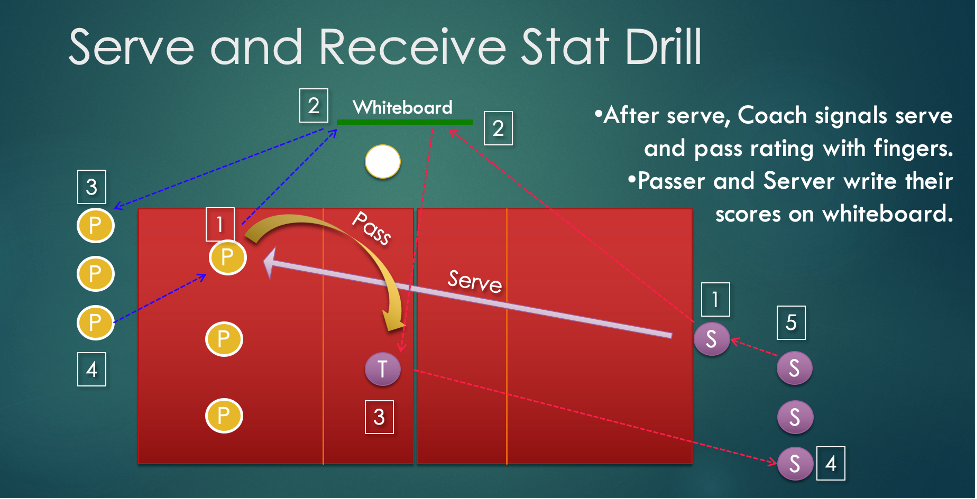
Serve and Receive Stat Drill
 
Goal: Stat players’ serve and receive error or success % as well as their serve and pass rating (on a 1-4 scale). Get them in a “game mode” so there’s higher focus and intensity.
 
How to do it:
  • Servers on one side, passers on the other. Coach rates pass and serve. (See diagram.)​​
Picture
Picture
​Back to top
 

3rd Focus: Setting
 
Using fingers to control the ball is an important skill and gets overlooked when players aren’t setters. Overhand ball control expands the players’ range of coverage. 
 
Technique:
  • Shape the ball with fingers and palms.
  • Look through the “window” created by thumbs and index fingers.
  • Ball should be above the forehead on contact.
  • Right foot forward, left foot back. Face the target and follow through with palms facing target.
​

Skill Drills - Setting

 
​Set to Self Drill

 
Goal: Learn to shape hands to the ball and use all fingers.
 
How to do it:
  • Hold the ball in your hands, then move your hands above your head.
  • Set the ball and catch the ball. Increase height gradually as contact gets better.
  • Shape the hands again making sure that the thumbs are down and around the ball and the index and middle fingers are holding the ball.
  • Use the wrist to set the ball.
  • Repeat 10 times.
  • As contact gets better, instead of catching, set the ball immediately.
Picture

Wall Setting Drill
 
Goal: Learn to use all fingers to set the ball consistently.
 
How to do it:
  • Mark a spot on a wall about 9 feet up.
  • Toss the ball to the wall and set it back to the wall.
  • Make sure to have hands high with arms almost straight out just a bit before locking elbows.  
  • Look at ball through “window” between thumb and index finger.
  • The ball should hit the player’s forehead if it were to slip through the fingers. Most times, hands are too low and ball will hit the chin.
  • Make 10 good sets to the spot. Make sure to shuffle feet with right foot slightly in front.​
Picture
 
Back to top

4th Focus: Digging

​When training digging, reward effort! You want players to be aggressive going after every ball, even when completely out of reach. Emphasize fun. Players should learn to slide on the floor and enjoy it, and the team should enthusiastically cheer on the effort.
 
Technique:
  • Feet wider than shoulders, parallel toes.
  • Face the ball.
  • Arms low and hands covering knees.
  • Be low enough to touch floor with finger.
  • Move platform to meet the ball. Make angles to rebound the ball up high and toward the center of the court.

Skill Drills - Digging


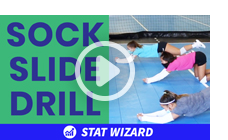
​Basic Slide Drill

 
Goal: Teach players how to slide safely and make it fun.
 
How to do it:
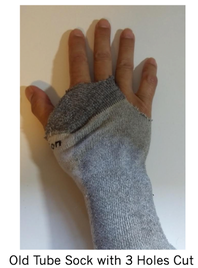
  • Get an old pair of socks. (Long tube socks are particularly good.) Cut 3 holes in both. Put hand into sock and put thumb, index and middle finger and last 2 fingers into each of 3 holes. See image to right.
  • Socks should cover the palm and forearms, possibly up to elbows to prevent floor burns from sliding.
  • Socks will also make sliding very smooth.
  • Player should have knee pads on.
  • Start on knees.
  • Reach and fall forward and slide on forearms.
  • Reach with dominant hand and catch the fall with the other hand, then slide.
  • Get low, take a step, reach with dominant hand and catch the fall with other hand, then slide.
  • Get smooth so that it’s quiet and body parts are not bumping on the floor.
  • Slide smoothly and as far as you can.​
  • Knee slide on both forearms.
  • Knee slide on one hand.
  • Standing slide.
Picture
Picture

Run Slide Drill
 
Goal: Have fun sliding.
 
How to do it:
  • Once players are confident in their sliding, have them line up on the end-line, run 2 steps and slide as far as they can.
  • Get up and run to the 10-foot line and slide. See who goes the farthest.
  • Make it a contest or just do slides at each line on the court from one side to the other.

​
​
Shuffle Slide Drill
 
Goal: Learn to slide sideways. (This is also a good conditioning drill.)
 
How to do it:
  • Have players in rows of 3 on the 10-foot lines and end-lines – all facing the coach who is off the court.
  • Coach will shuffle left or right, then yell “slide” and players will slide to their side on their belly.
Picture

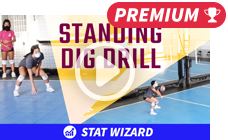
Standing Dig Drill
 
Goal: Learn the proper stance and platform for digging a spike.
 
How to do it:
  • Form a single line at end-line.
  • Balls in a basket next to coach at 10-foot line.
  • Coach hits balls at the players.
  • Player must move into the court, make a wide stance and touch the floor before coach hits.
  • Coach hits into platform.
  • Player digs and shags ball, puts it in the basket, returns to the line.
  • Looking to get 10 good digs.
Picture

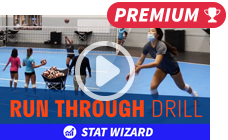
Run Through Drill

Goal: Learn to chase a ball and direct it back to the court.
 
How to do it:
  • Form a single line in either corner.
  • Coach stands at 10-foot line with basket.
  • Coach tosses ball out in front of player, player runs and bumps ball to setter location.
  • Player shags ball.
  • Coach tosses to next player. Coach can toss the ball out in front of player to make it more or less challenging depending on the skill of each player.​
Picture
 
Back to top

5th Focus: Hitting

​At this level of play, it’s not very important to jump and spike the ball. It’s more important to learn good hand contact, arm extension and power generation. Hit down balls (feet on the floor) and practice shuffling to position – ball in front of hitting shoulder. Don't be under the ball.
 
Technique:
  • Hand contact
    • Big hand.
    • Thumb to the side, fingers wide and loose.
    • Solid contact with middle of palm.
    • Snap with wrist.
  • Arm swing
    • Elbow high, ear level behind head.
    • Twist at waist.
    • Lead with shoulder, then elbow, then forearm snap.
  • Approach
    • Right handers – 3 step: left, right, left
    • Small to big steps
    • Slow to fast steps
    • Swing arms back on Step 2 and drive them upwards
​

Skill Drills - Hitting


​Wrist Snap Bounce Drill
 
Goal: Learn how much power can be generated through quick wrist snap.
 
How to do it:
  • Players hold a ball in their non-hitting hand at waist level in front of their hitting hand.
  • Using just the open hand and wrist, snap the ball to the floor.
  • See how high a bounce you get.
  • Do it 10 times, attempting to get a better snap and full hand contact on the ball for a higher bounce.


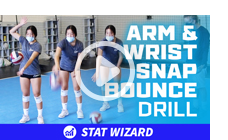
​Arm and Wrist Snap Bounce Drill


Goal: Same as above but with more power, bounce the ball as high as possible.
 
How to do it:
  • Same as "Wrist Snap Bounce," only start with hand up and elbow high.
  • Make a wood chopping motion through the ball, snapping at the elbow and wrist.
  • Bounce the ball as high as possible.
  • Have a team contest to see who can bounce it highest.
Picture

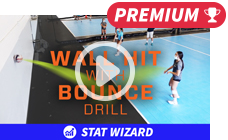
​Wall Hit with Bounce Drill
 
Goal: To make strong, controlled contact of a ball that’s in the air.
 
How to do it:
  • Stand 15 feet from a wall.
  • Toss ball up high and hit it to the floor just in front of the wall so the ball bounces back up.
  • Make sure to pull elbow back and swing through the ball, full hand contact and snap.
  • Learn to hit in a controlled manner so you can hit the ball again.
  • Try to hit 4 in a row. Ball should be above the head. If not, stop and start over.


​Wall Hit Drill

 
Goal: Learn to swing high and hard to drive the ball above the net like a Down Ball hit.
 
How to do it: 
  • Start 10 feet from a wall, mark a spot about 9 feet up.
  • Toss the ball high (basketball rim height – 10 feet.)
  • Swing and hit the ball to the spot.
  • Try to have power and accuracy.
  • If it’s easy, move back 3 steps and repeat.
Picture

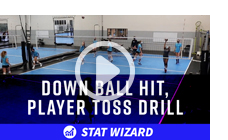
Down Ball Hit, Player Toss Drill
 
Goal: Hit an actual down ball over the net.
 
How to do it:
  • Form 2 lines at the end-line.
  • First player moves to the 15-foot line and has a ball.
  • All players should grab a ball.
  • Front player tosses ball vertically about 10 feet straight up.
  • First player in line approaches and hits a Down Ball standing on the floor, swinging high and over the net into the other court.
  • Tosser shags, hitter gets ball from ball cart and tosses the next ball.
  • Coach should walk around and help hitters and tossers, guide the flow.
  • Set a goal – for instance, 10 balls hit into the court. Everyone counts.
Picture
 
Back to top

Final Focus: Team Play
 
Learning how to play as a team is the next important step because it brings all of the skills together.  Because ball control in volleyball is so difficult, it’s important to find “games” that allow players to begin learning Pass-Set-Hit.
​

Team Play Drills


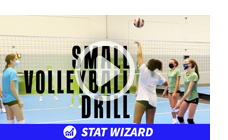
Small Volleyball Drill
 
Goal: Learn Pass-Set-Hit in a full-court 6 on 6 setup.
 
How to do it:
  • Form doubles pods on the court with 2 players next to each other doing pass-set-hit. 
  • Attempt to pass to the center and close to the net and setter setting 15 feet to the pin.
  • Pass the ball straight up and high to the next closest player. This player bumps or sets the ball straight up, and the passer hits a down ball. 
  • Coach initiates by tossing ball into the court.
  • Rotate after each rally.
  • Score to 10 and switch sides or shuffle players.
Picture

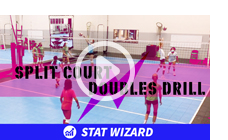
Split Court Doubles Drill

Goal: Get more touches and learn to serve, pass, hit, dig. Learn ball control; the narrow court requires good control and also provides more touches since there are fewer players. 

​How to do it:
  • Place an antenna in the middle of the net. Use a disk or cone to mark the middle of the end-line. 
  • Teams will play on the right or left side using the full depth of the court.
  • Play doubles or triples on each side.
  • Serve and play normal volleyball, only on a court that is half as wide.
  • Play to a lower number and run a tournament so each team plays another team.
  • Keep track of wins and losses.
Picture

Short Court Drill

Goal: Learn softer touch and control inside the 10-foot line. Learn to bump, set and hit or tip with control. 

How to do it:
  • Have 3 to 4 players on each side.
  • Start with a toss-in from just behind the 10-foot line.
  • Serve and play normal volleyball, only on a court that is full width but short. 
  • Play to a lower number and run a tournament so each team plays another team.
  • Keep track of wins and losses.
Picture

Small Court Drill

Goal: Learn to play full volleyball and get better at serving, passing, setting, hitting and digging.  Fewer players mean more touches.

​How to do it:
  • Use caution tape from one end-line, over the net, to the other end line. If there are basketball hoops, tie it to that at each end to keep the tape off the ground. You can also attach to blocking boxes or bleachers.
  • Teams will play over this tape on each side of the court.
  • 3 players per quadrant.
  • Serve and play normal volleyball, only on a court that is half as wide.
  • Play to a lower number and run a tournament so each team plays another team.
  • Keep track of wins and losses.
Picture
Back to top

Establishing Performance Benchmarks

​You have to know how good your stats need to be to achieve your goals. That means answering two questions: Are your stats good enough to be competitive locally and nationally? How well do you need to SERVE, RECEIVE and ATTACK to win?
 
Click here to get more information about how to set statistical benchmarks for your team.
Questions? Contact us here!
Picture
Plan faster | Train smarter | Play harder
in partnership with
Picture
 SoloStats stat apps are completely FREE for taking stats. Choose the app that is appropriate for your needs from practice to matches to beach.
Proudly powered by Weebly